Leaving Phuket: Post regatta, we spent 3 days in Phuket based at the Ao Po marina at the foot of lovely Phang Na Bay – the errand and job list was long: pick up the sail repair, pick up the dinghy repair (the Honda idiots in Singapore had put 2 stoke fuel in our 4 stroke engine and stuffed the carburettor), provisioning for 5 weeks across 3 supermarkets, get a generator part welded, laundry, wash the boat and everything on and in it. It was a frantically busy 3 days and Henry braved the crazy Phuket traffic with a hire car so that we could complete all the tasks, and we managed to fit in two ice-creams! We had an unfortunate up-close-and-personal encounter with the bow anchor of a large power boat when leaving the marina, resulting in the smashing of our port side solar panel. The lovely 20 mile sail south to Nai Harn bay was peppered by frantic phone calls around Phuket to try and secure another solar panel so as not to compromise our power generation ability, in particular to keep the beers cold! Octopus marine – Mick Keely – came to the party with an in-stock panel which he delivered to the Phuket Yacht Club resort at 0930 the next morning. We hitched a dinghy ride to shore, then a truck ride to the resort with a couple of curious Thais and picked up the panel. We must have looked pretty incongruous on lovely Nai Harn beach: two yachties carrying a 4 x 2 foot cardboard box, standing ankle deep in the shallows waiting to board a long-tail boat…amongst all the semi- naked sun worshippers and beach combers. As I write, Henry is busy getting it ready to install, in Port Blair (on the sole of the salon floor!). Our sail to the Andaman Islands took a smidge short of 72 hours. Not entirely comfortable and not enough wind, so too much motor-sailing. A highlight was a lovely escort of dolphins during the second morning. And so was our passage to India. Then into the throes of port entry: the Brits invented bureaucracy, but the Indians have sure perfected it!
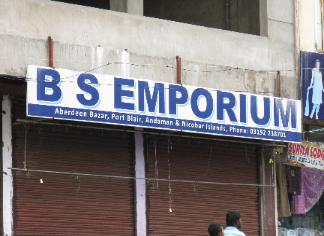
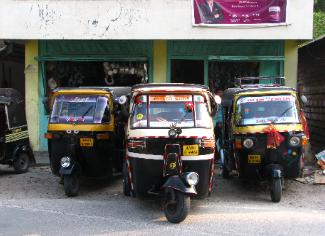
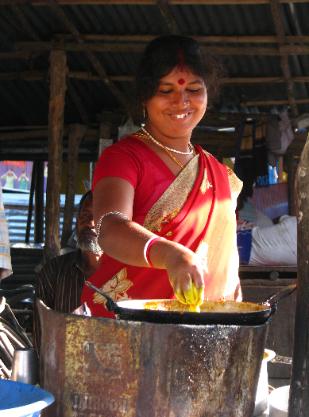
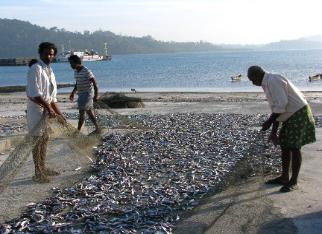
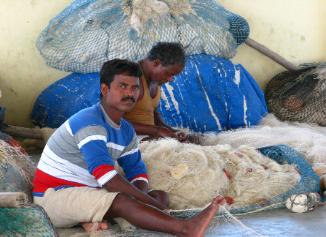
The Paperman Commeth! We dropped the hook into the official entry anchorage around 1000am. The first officials to arrive were the Navy: all 6 of them, who sat in the cockpit and shuffled paper like a pack of cards. Our boat was photographed; we were photographed, as was the chart table and electronic instrumentation. We exchanged papers, much rubber stamping went on, and they departed with a handshake. About two hours later came Customs: these were the fellows we were a bit wary of as we were carrying over the limit of alcohol and we had heard that they made pointed requests for a gift of unopened whiskey (presumably to sell downstream). They went through our copious prepared lists of provisions and booze and did make a request for whiskey, but we skipped over that, basically ignored it and were able to get away without a bribe. Next came the Immigration Department – same round of paperwork and questions, lots more stamping and shuffling of paper. Between these official visits we were trying to get the dinghy working so we could go to shore the next day, but, despite the recent service in Phuket, it was not co-operating. The guys put their heads together and identified an issue with the fuel supply so that was our next project. The following day all four boats went to town for the Harbour-Masters visit – more meetings, paperwork and stamping! Banks were visited and the girls hit the market for fresh produce! Feb 15-17 Port Blair We are truly in India! Port Blair is everything that is the sub-continent of India – the smells, crazy traffic, honking cars, the 3-wheel Tuk-tuks (Auto-rickshaw), the 1956 style Ambassador cars, women in colourful saris, the wandering holy cows and their associated dung: a bustling and random society going about its business. Like the sub-continent, it fills every corner of your senses. After the Harbour master/bank/market adventure, we sought lunch, returned to the boats and then ventured out again for a terrific Indian dinner at the Emerald hotel that was amazingly in-expensive. Worth mentioning is the wonderful Ravi: a local taxi driver who acts as a guide and concierge. If you want it he can get it. There are 100,000 people living in Port Blair – it is India’s eastern-most real estate and geographically is a mid-ocean ridge. The island is populated by many government (defence), administrative and private businesses and probably houses the largest collection of ageing, shabby ships that we have ever seen. There is one in particular: Warship – which parades the port announcing that it is the warship! It appears to be of Second World War vintage. We did some quick (not) internet emails on some very old computers that did not recognise Microsoft Word documents and portrayed them as 1’s and 0’s and gave up on any internet surfing (we had wanted to do some research). We are cruising with a fun bunch of friends: Rusalka (Kevan & Shiela with whom we do the Phang Na Bay regattas), Rascal (Carol & Gavin with whom we did the Raja Muda) and Smystery (Charlie and Susie with whom we’ve competed in past Kings Cups and Phang Na Bay regattas). Basically, this is the Langkawi and Phuket group we have come to know well over the years. They’re a talented and experienced group of sailors and a bunch of fun. Feb 20-21 Havelock Island A 20 mile sail got us to a lovely turquoise clear water venue called Havelock. This is the most commercialised island in the group, in that it is almost purely dedicated to resorts. We use the term “resort” loosely here… these are mostly rustic backpacker places with only one or two that would be acceptable to our standards. Yet we thoroughly enjoyed ourselves, once again at the open vegetable market, the small shabby town with everyone in Indian clothing. The island is very green, as are most of the Andaman’s, and one outstanding thing about Havelock was the forest of big trees that occupied all the fore- shore: they are truly magnificent. The one downside was the beach landings in the dinghy: all appears smooth but there is a sandbar and dip just preceding the shore, which generates a fast one meter high wave. Not a bother if you’re swimming and a delight if you’ re surfing, but dinghy landings and departures – watch out! All but one of our dinghy party was pooped, dumped on and rolled resulting in wet everything. Our dinghy engine – which we had got working in Port Blair, got a good dose of salt water during a pooping and struggled to start for the return journey, resulting in us having to row and eventually get towed back to Dreamcatcher by Smystery’s dinghy. We had then gone to shore the next night in Rascal’s dinghy, made it ok, but had an awful surf-battered departure, got completely soaked and the dinghy half full of water. We had to try and drain it at the water’ s edge between waves, as it was too heavy to drag. It took us another half an hour on the beach getting it sorted out, then we eventually got under way, a very sorry salty lot! Ah, the joys of cruising! Feb 22, 2012 The group weighed anchor at 1000 and motored around the corner to Laccam Harbour, on the north of Havelock Island. A squeezy anchorage amidst small wooden fishing boats and a couple of industrial ferries. Sadly, we couldn’t get the dinghy engine going – Henry spent the best part of 3 hours on it: very frustrating. GT did go to shore with one of the other dinghies and had a quick Indian lunch in the town overlooking the anchorage (at the restaurant that had lost its liquor license and was “dry”). We managed to smuggle some gin in a water bottle and topped up the multiple 7-Ups we’d ordered. Henry got yelled at by a ferry boat driver for anchoring too close to the channel (mind you, if he couldn’t get his boat into the large space, he shouldn’t have been a ferry captain anyway!). India, and thus, the Andaman’s, governs liquor very tightly – it’s hard for the locals to obtain and what bars there are are hidden away and operated in dimly lit rooms with a strong sense of “taboo”. The girls took another trip to the Havelock market and bought some more wonderful fresh veggies, and then all boats weighed anchor mid- afternoon, bound for Kwantung Strait, between Havelock and Henry Lawrence island. We had a lovely dinner aboard Rusalka in deep green water opposite and attractive cliff shoreline. One downside of the Andaman’s is that the swimming and snorkelling has not really been an option, due to an increase in the crocodile population. The Tsunami of 2004 wreaked havoc with the Andaman’s: 40,000 lives, or 10% of the population perished and the islands themselves were physically shaken up and shifted up to half a mile in different directions. This is why sailing here is challenging, as the navigational charts are “fictional” and “useless” according to pilot guides and prior cruisers. The charts are a combination of 1857 Indian surveys and a 2001 British Admiralty hydrographic survey, both pre-tsunami, so everything’s a bit of a gamble and depths vary widely from those stated on the chart, sometimes by as much as 20 meters. The natural mangrove habitat of crocodiles was physically changed so that the crocs have changed location, closer to the human settlements, and whilst we haven’t seen any to date, we’re not keen on an up close and personal encounter! Feb 23, 2012 Inglis, Outram and Long Islands Our cruising pals – all of whom have been to the Andaman’s before – set a cracking pace and this was the day we anchored in 3 different locations! Dreamcatcher’s cruising style prefers at least a 2 night stop and more if the local scene is interesting. Nevertheless we join in and head to Inglis Island – a bright white sand and blue water stop. Henry tackles the dinghy engine again, but no go. As the wind picks up we decide to weigh anchor after a couple of hours and head to Outram Island. We drop the hook in 20 meters opposite a lovely looking island, but it is too late to go ashore, and we have a lovely dinner aboard Rascal. A big plus about the Andaman’s, brought about by its’ remoteness (400 miles from Calcutta and 400 miles from Phuket, Thailand), is that there are very few boats here. The most we have seen is 10, in the Port Blair check-in anchorage, so it is still very much an undiscovered cruising ground. There is some tourism, but low-key back-packer type and the Indian mind-set is not about tourism…. Here, it is largely defence. Tourism could be a big money-spinner for the Andamans, positioned as India’s Hawaii – but the infrastructure and mind-set is not there.
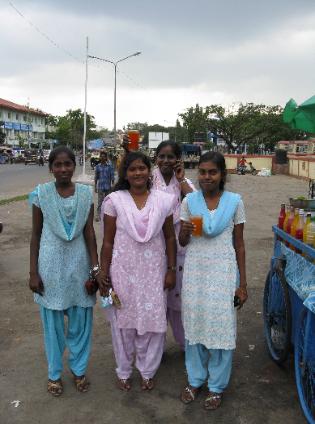
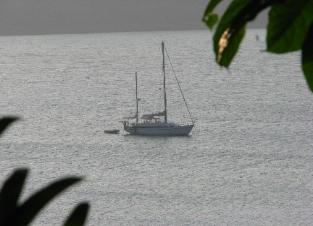
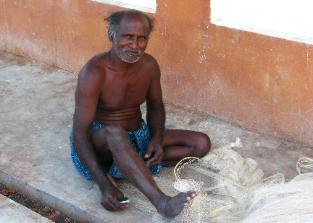
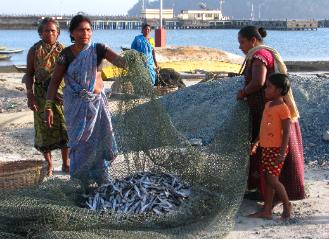
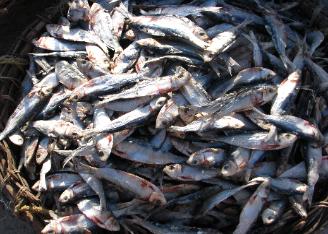
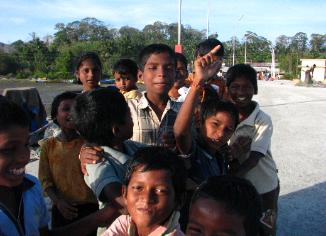
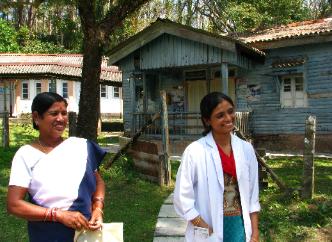
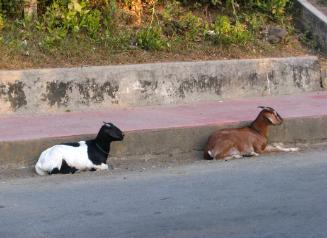
We arrive in Long Island after a 18-20 knot slog on the nose, and drop anchor in 5 meters near a steep shaley beach. A lovely dinner aboard the Rascal puts us all to bed, very tired. We have, at this point had to accept the fact that our dinghy engine is not working, which makes us dependent on the other boats for lifts to shore and back. But there is nothing we can do – there are no mechanics or engine shops around and Kevin off Rusalka has looked at it with Henry, and pronounced it temporarily dead. The lovely folks from Smystery took us to shore the next morning for a walk around this pretty island, population 1500. Long Island had a prior industry of boat building: this stopped when logging was banned in the Andamans and the community needed to be subsidised. Hence there is this neat, little village with lots of uniformed officialdom! It always strikes us too that tiny societies like this, are able to keep their school children beautifully uniformed and tidy, whereas first world western countries’ school kids tend to look like a bunch of dishevelled brats! We have some lovely photos of the school girls, with long looped plaited pig-tails, complete with bows, doing their homework in dad’s chai shop. Long Island was neat, pretty and organised. We met the chief of Police on his request, to sign in and on arrival he was dressed in just a wrap sarong. He went into a room, changed into long grey pants and white shirt (really, just for us!) and summoned several of his staff. Our visits attract a lot of attention from the local officials and they treat the whole process with a great degree of formality. There is much rustling of papers, stamping of stamps and formal hand-shaking. Goats, cows and a donkey populated the Long Island sports field and the whole place exhibited rustic, ramshackle wooden houses, many of which were water-front with billion dollar views. There is no glass available for Long Island, so everything is made from wood or scraps of wire and twine washed up on the beach, and nobody has any normal windows. We bought some veggies from a lovely wizened elderly Indian man, and he was very grateful for our custom and asked us to come again. Once more, another order of take- away Samosas from the only “restaurant” in town. They had 3 choices for breakfast, 2 for lunch and 1 for dinner! They had one table and it was surrounded by scratching chickens and the occasional goat as well as several of the villagers who came to look at the “foreigners” drinking their chai. While we were conscious that we were a curiosity, we never ever felt threatened or uncomfortable. These are good people. A walk to the top of the hill took us to the hospital where Charlie had gone a couple of years prior to attend a minor injury. We spoke to the lady doctor for some time – very interesting. This is where we had long discussions with our cruising pals as to whether to go west through the Homfrey Straits (with an uncertain overhead power line height) or to stay on the eastern side of the Andamans. The former offered an exciting trip through a river-like path to the western side of North Andaman island, and a passage up to remote and unpopulated Interview Island and then a subsequent choice to return to the east side the same way, or go “over the top” – a somewhat hazardous trip. We opted to stay on the east side, along with Rascal, who had valid concerns over the height of her 23 meter mast…. And so the little fleet split two and two, with an agreement to meet up in Port Cornwallis on the NE corner of N. Andaman Islands four days hence. Feb 24 Rangat Bay The Rascals and we set off mid-morning for the 8 mile on-the-nose (wind) drive to Rangat Bay. It’s a small sheltered port behind a substantial breakwater. We anchored between the breakwater and the big concrete ferry dock, in calm water. Henry and Gavin went ashore with the essential paperwork and met the Port Captain who apparently was a charming fellow who ordered Fanta’s all round. The four of us then proceeded to town. All these land based outings are preceded by a dinghy landing – many of which are a 10 on the scale of “degree of difficulty”. There are few jetties at which one would risk leaving one’ s dinghy, as what jetties exist, are built for mid-sized ferries. At Rangat, we chose to use the cement fishing boat ramp and conned the dinghy into the murky shallows, between the fishing canoes and avoiding the coral bombies. When we finally got in shallow enough to get over the side, we ended up in squishy mud. Carol went in up to her knees and thus lost both shoes! With some effort and frustration, we managed to get the dinghy up the slippery, fish-scale covered ramp and parked on the concrete. This immediately attracted a crowd of admiring kids and some adults, who were fascinated with the dinghy and its’ engine. As we passage further north in the Andamans, it’s apparent that few yachts reach here. Rangat Bay is not exactly the garden spot of the world either and is not able (and has probably not tried) to attract the backpacker or sub-continent Indian tourists that some of the other islands. Nevertheless, after a hairy and cramped taxi ride into the town we managed to find a shoe shop to get Carol some footwear, and after which, found the markets. It is surprising how good the vegetables are in the Andamans: Fruit tends to be limited to small bananas and small local mangoes, but the vegetables are plentiful, fresh and plump. Almost all vegies, and certainly those used in Indian cooking, are available. There are a few “general stores” selling tinned and packaged food, lentils and bottled water, but not much else apart from the one-man roadside stalls cooking up samosas, bhajis and other spicy treats. There was a small fish market in Rangat, but the fish – whilst likely caught that morning – looked awful covered in flies! We’re told that’s a good sign and that fish without flies has likely been wiped down with bleach and may be at least a day old. Nevertheless, we passed on the protein and had an early night aboard in preparation for our o-dark-hundred departure for Maya Bandar. Feb 24-26 Maya Bandar (or Bundar) I hate these early starts (Henry likes them), but it makes so much sense to get under way early, ensuring a lunchtime arrival and the opportunity to explore the local town. The recommended anchorage in Maya Banda looked idyllic (white sand, blue water, coconut palms) but was exposed to the NNE winds and surrounded by coral reef, and was untenable as an overnight anchorage. So, Rascal and Dreamcatcher spent about an hour wandering through this expansive harbour and finally dropped the hook near the ship dock. Not a terrific outlook, but behind us was quite pretty – water and mangrove covered islands. Gavin had discovered an excellent landing point that didn’t require getting wet up to thigh level: we tied on to a very rusty old coast guard boat that clearly hadn’t gone anywhere for some time, were able to walk across that onto a large floating pontoon, then a leap across the water to some concrete steps on to the large ship dock. All a bit agricultural, and close to life-threatening at night, but nice not to get wet. Unfortunately, by the time we’d done this two or three times, the white canvas cover on Rascal’s dinghy was filthy with rusty footprints. We all liked Maya Bandar: it is the official capital of the North Andaman region and thus peppered with official residences and administrative offices, and cleaner than other towns we’d seen. The Indians love their bureaucracy and we were “accosted” on the dock on our first arrival by some bloke who said he was a policeman and wanted all our details. He had no uniform, badge, no ledger book (and they love their ledger books!). Anyway, after about 30 mins of him hand writing down everything that we had already told Port Control (don’t these guys talk to each other?!) we were allowed to explore the town. It was very pleasant (by Indian standards) and we found several vegetable sellers and samosa cookers. We did discover a great restaurant (the only one in town) and dined there both nights, it was soooo good! And inexpensive. The concept of a restaurant as we know it, is very new in this part of the world. Fortunately this place was run by a lovely Burmese couple who understood good food and tried their best to deliver an excellent meal. The notion of a bar is also embryonic, as is the notion of keeping drinks cold. The Kingfisher beers were cool but not cold: perhaps some of this had to do with the power black-outs Maya Bandar experienced while we were there. The other thing we discovered is that these northern Andamanians don’t believe in light beer: every beer available is a strong 8.8% alcohol Kingfisher – we all got knocked on our butts the first couple of drink rounds! But we did enjoy this town of about 10,000 people. We were committed to sail one more port north to Port Cornelius, the next morning but Henry had an awful inflammation develop in his ankle, was in a lot of pain and running a fever. This was from an injury sustained during the Phang Na Bay regatta 3 weeks prior that had never healed properly and had now developed in to septicaemia. So, off we went to the Maya Bandar hospital. What an experience – a 30 bed untidy but clean hospital with queues of Indians at every window and door. One had to queue for a slip which then entitled one to join the queue to see the doctor. The doctor’s door was left open, no privacy, and we were escorted in while he was tending to the prior patient. Of course, we stuck out like sore thumbs, being foreigners and were quickly queue-jumped by the Indian hospital administrators to first served. We found this unnecessary and embarrassing as we were quite prepared to queue and did not wish to be seen as being superior to the locals. Nevertheless they insisted on ushering Henry in first to see a very smart doctor, who recommended an x-ray, anti-biotics and all the things we expected. It was a positive and ultra-interesting experience to be in the grips of an Indian hospital, in one of the remotest island groups of the world. We tried to pay but were assured several times it was not necessary as it was a “Government Hospital” and that all services and medications were free. So, consultation, x-ray and drugs, for nothing, and out in under an hour. We celebrated with some Indian spicy donuts and a lovely noodle lunch aboard Rascal and then sent Henry to bed to recover for the rest of the day. Feb 26-27, 2012 Diglipur/Port Cornwallis An early start set us on yet another 20 mile passage due north to Diglipur. Through all these short passages, one is required to report the boat’s and other details by HF radio at 0800 and 1700. The rationale for this is a mix between a 19th century commitment to bureaucracy and a need from a defence standpoint, as the Andaman function is primarily that. I’m sure we gave them heartburn as they were trying to track down these four itinerant sailboats. Unfortunately, it was another upwind slog on the nose, and as we wanted to be there mid-afternoon to ensure a planned rendezvous with Rusalka and Smystery, we ended up bashing to windward much of the way. Unfortunately we had backed over the dinghy painter while anchoring Dreamcatcher and succeeded in putting 4 wraps around the prop shaft (groan). Both Henry and I tried to free it by taking turns in the water with snorkels, after being told this was a “no crocodile” environment by the port captain. Kevan afterwards slashed the line off with a breadknife, only to be told later that a large croc had in fact been sighted at the wharf a few weeks prior (Yikes!). We had lovely re-union drinks aboard Dreamcatcher, swapped stories of where they’d been and what we’ d done for the prior 4 days, and then headed off to dinner at the only restaurant in Diglipur, about 8 km from the anchorage. These Andaman drivers only have one speed: flat out, and once again, a hair-raising ride, in more ways than one: the cars here have no windows. We left the anchorage next morning and sought permission to anchor off Ross and Smith islands: pretty islands joined by a sparkling 200 meter wide sand spit. We dropped anchor and went ashore in Rascal’s dinghy to clean the Maya Bandar rust footprints off, and to enjoy a swim. More Indian bureaucracy – we weren’t allowed to land or swim there unless we had (yet another) permit and 500 rupees ($15) per person. This piece of delightful real estate – about 200 x 30 meters – had no less than 3 Indian officials: they (and Gavin) spent a lot of time on the phone reporting us and seeking to allow us to stay there for a few hours. Permission denied, so we begrudgingly re-boarded the dinghy and returned to the boats, albeit lingering on the way to admire the sea turtles and manta rays swimming in the shallow water. Tourism in the Andamans is definitely NOT top of mind! We remained at anchor is this pretty spot overnight and turned south-bound. An interesting factoid discovered by Rusalka (during afternoon tea with the Police at Landfall Island, where they had never ever seen a sailboat..) …was that the Coco Islands that geophysically appear as part of the Andamans, are in fact Burmese, but the Burma junta has leased them both to China. So, China has a defence holding in the Indian Ocean: you bet the Indians are happy about that NOT)! Feb 27/8 Maya Bandar (second time around) Enroute into this generous bay, Carol caught her first fish. This small fleet are expert fishers – particularly Susie on Smystery – and many fishing tales were exchanged and photos proudly shown. Rusalka had also caught about 4 : Dreamcatcher remains fish-less at this point. Rascal and we stopped at Alves Island (the recommended anchorage we found untenable earlier in the week) on the way in. The wind was less than before and the island was very pretty: acqua water, inshore reef, white sand and a semi-commercial coconut plantation. There were two occupants - older men of very small stature – not Indian Indians, but likely origins from one of the Andaman tribal groups. We had a short chat with them, a walk along the beach and a lovely swim before returning to our prior anchorage. By now, we and Rascal were the “experts” on Maya Bandar, having spent 3 nights there enroute north. Also, by now, Henry’s ankle had shown some improvement, but not enough and it swelled and reddened again badly after our arrival. Both the drugs and the general fighting of the infection made him listless, and it was very hot. The Rusalkans spurred us into going back to the hospital and getting another course of anti-biotics. On arrival, the hospital was deserted – a contrast to our last visit. Deserted, that is, except for two holy cows who were happily grazing undisturbed in what was the cross between the garden and a construction site (for the extensions). We eventually saw another very good doctor who gave Henry much more powerful anti-biotics than the first lot and instructions to rest and elevate the leg for the next week. Hmm. In Henry’s own words “they knocked me on my arse”! GT visited the town again with Smystery, shopped for veggies and eggs and enjoyed a samosa and local soft drink with them. Samosa’s have been our staple snack on much of the voyage and we are now experts on pastry and fillings of same! Buttoned Up! Feb 28 North Button Island. There are 3 Buttons: north, middle and south. The latter two are not navigable for anchoring but do provide good visual waypoints. North Button is about the size of 3 tennis courts and as pretty as a picture. Rascal approached from the west, we from the east, giving the extremes a very wide berth. We found our way into 11 meters of bright acqua blue water and dropped the hook facing a heavily treed white limestone cliff, backing a bright white sand beach. Absolutely lovely! GT went ashore with the Rascals and swam and beach-combed a bit until the sand flies took a liking to us, then it was back in the dinghy, enroute to Dreamcatcher where we hosted dinner for the fleet that night. Another great evening, happily passing out about 2200. Everyone’s wine/booze stocks are holding up well despite us giving them a good bash each night and we seem to have the best ice- cube system so are happy to supply ice blocks to the hosting dinner boat. We are not lacking for anything – this is a 5-star cruise, particularly in the F&B department! We are humbled by the culinary skills of the other 3 boats (read, Ladies aboard same) and hope we just got a pass mark on the cocktail/dinner delivery. We reluctantly followed the other boats when they departed the next morning: we could have stayed another couple of days swimming and simply staring at this idyllic tropical island.
The other 3 boats swung into Laccam Harbour (north end of Havelock) again, for lunch and provisions, but we chose to go straight to Havelock 7 as we weren’t keen on the Laccam anchorage: squeezy, reefy and noisy with local ferry operators. Plus it would have meant a beach landing for Henry, whose ankle still had an open wound and was looking angry, albeit improved from two days prior. We anchored at Havelock in 8 meters of deep turquoise water, GT had a swim, clean up and we stared at the amazing forest on the beach once again. We were dining aboard Smystery, having all agreed on not going ashore, given the all-too-exciting dinghy landings. We were up early the next day, around 0630 (it’s light here at 0500) and to our delight saw an elephant bathing with his mahout, in the shallows! We knew there were elephants on Havelock as we’d had to step around the dung piles enroute to the “resort” on our first visit, so seeing this one frolicking – if you can imagine an elephant frolicking – was a real treat. He was medium sized, with well developed tusks and spent nearly an hour in the water, sometimes doing a complete 360 roll – it was funny to see 4 legs and one trunk pointing skywards from the sea! It really was a magical sight – pale blue dawn sky, a forest of magnificent trees, aqua blue water, and one very happy elephant. The flotilla weighed anchor soon after breakfast, bound south to Chiryatapu. March 1 Chiryatapu, South Andaman Island This was the culmination of a 36 mile sail/motor from Havelock 7. It was a lovely blue-sky day with some wind in our favour, some not. This anchorage is a big, accommodating circular inlet – likely the ridges of a very old volcano. As we turned in, the wind kicked up to 15 knots (now!!?). There is a low flat rock (about 10 meters in diameter) that is barely visible above the surface and we had a visual on it coming in, but lost it in the wind-waves – a bit concerning. The rock is on the Admiralty charts, but in the wrong place by about 200 meters, so, when we eventually sighted it again gave it a wide berth and anchored in 15 meters. This is a lovely calm anchorage off a small beach that was populated by half a dozen thatched huts and a collection of cars – Sunday afternoon visitors – as this location is reachable by road from Port Blair. We didn’t go ashore, but watched the shoreline activities from the boat. It’s interesting watching ladies wading in sari’s! One thing we noted is that in all the Andamans, no women wear anything but traditional Indian sari or salwar kameez: unlike the cities on the mainland where some women (particularly business women) have gone for western garb. One noticeable feature of the beach here was a number of very large, dead, fallen trees. These are the same magnificent trees that line the waterfront and hills of many Andaman islands. They are truly handsome and we will try to find out their species when in Port Blair. As a result of the 2004 earthquake that caused the Tsunami, the southern Andamans dropped and the northern Andamans were lifted so now the whole chain tilts, so, these trees were tipped into the ocean’s edge where they lie today as huge grey-white skeletons. There has been no attempt to remove them nor saw them up. Let sleeping trees lie. We liked this anchorage a lot and look forward to a return. March 2-3 In Cinque We had a great 10 knot breeze when we exited the Chiriyatapu anchorage and put all sails up for the 14 mile sail south to North Cinque island. The pair – north and south Cinque’s are the southern-most of the South Andaman Island group and are nearly joined together by a reef. All Andaman islands are surrounded by reef, and as mentioned before, some inaccurately charted and not showing the Tsunami shift effect of 2004, so every new anchorage brings a little uncertainty and stress along with it. We’re fortunate that our cruising companions have been to many of these spots before and are able to give us some guidance. We dropped the hook in Minto Bay and settled in for the afternoon and ensuing evening on Rusalka: we’ve been sharing the hosting of dinners and doing the rounds of each boat. The host boat provides the party platform, all the drinks, the main course, the quiz for the evening (yes, really!) and the other boats bring a contribution of starters, desert or a main course support dish. We’ve had some truly outstanding feasts and really enjoyable evenings! The anchorage was a bit rolly as the wind has not been behaving and coming from its’ promised NE direction. That triggered us to leave early the next morning for a 3 mile motor around the corner to South Cinque island. This anchorage was pristine, aqua blue water over pure white sand surrounded by heavily treed hills and yet again we had it to ourselves. One GT couldn’t resist the urge to jump in and swam the 250 meters to shore, through an exciting surf break. It was nice to walk on the beach for an hour and I enjoyed the swim back to Rusalka who were happy to provide a beer and chat before the return swim to Dreamcatcher. Around 4pm, this lovely anchorage too became rolly and the armada made a quick decision to up anchor, accompanied by a dolphin pod, and motor 5 miles around the southern end of South Cinque and back up the other (eastern) side of North Cinque where Smystery hosted another lovely dinner and another great quiz. Time to return to our respective boats as the swell came up : we had a pretty scary boarding from Rascal’s dinghy onto Dreamcatcher and spent the night rolling from side to side in a very uncomfortable seaway. Apparently earlier trips that our cruising companions had done were much calmer and dinghy landings on the beach were possible – not this time. Nevertheless, the morning was calmer and spent snorkelling over the reef sighting at least two dozen varieties of beautifully marked and coloured tropical fish. It is quite remarkable to be in a place of zero population, as are many of the Andaman islands. Also quite unique not to sight any other sail boats for weeks at a time. Mid afternoon, we set sail again, returning to Chiryatapu on the start of our passage north to Port Blair to start the wind-down and exit process from the Andamans. The Chiryatapu anchorage offered a welcome calm after the rolly Cinque’s. We dined aboard Rascal, again, another great evening and all turned in early for a long, deep sleep. While we don’t want this adventure to end, a stores inventory revealed we’re getting close the finish of our fresh goods: only 4 litres of drinking water, no bread and only 1 egg left, all veggies except the onions and garlics are all used up. So, Port Blair markets, here we come!! Ross Island and Port Blair March 8/9 Ross Island is right next door to Port Blair and apparently a very interesting place, being the British HQ, a prison and Japanese holding in past years. We were given permission to anchor by Port Control but were knocked back from entering the island by the Forestry management: more Indian rules!! Despite phone conflabs with various officials we were turned back, on the basis it was the day before a public holiday. What we did see was the herd of spotted deer (some with handsome antlers) that populated the front lawn. Very odd seeing Christmas-card type deer in the middle of the tropical Indian Ocean. On our return to Port Blair, the wonderful Ravi met us at the dock and we did some rounds of shopping, lunch, more samosas etc. About half the shops were closed due to the Holi day, the Indian festival where they pelt each other with coloured paint. There were brightly coloured splotches all over the pavement and many of the younger men were simply technicoloured. We arranged diesel fuel with Ravi for delivery to the dock the following day, in preparation for our departure to the Similan Islands (Thailand). This is where the hassle started. March 10 & 11 Port Blair departure If we haven’t said enough positive things about Ravi – let us state it again: a wonderful human being, humble, completely honest, unbelievably helpful and just so easy to work with. Rascal needed 400 litres of fuel, Dreamcatcher 250. We gave the money to Ravi to purchase the fuel and deliver to the docks the next morning. He did so and arrived with 44 gallon drums and jugs on the back of an auto-rickshaw, and we all helped Rascal to get into the inner harbour, tie up and start taking on fuel. About 15 minutes later, 3 Customs officers arrived and made a big nasty scene about us breaking the law and illegally exporting fuel. Dreamcatcher’s name was on the receipt so Henry was given a particularly hard time. They seemed to be on an absolute witch hunt and were unbelievably rude and belligerent. By now a crowd had drawn to see we foreigners being berated. They cut off the fuel supply to Rascal, impounded the remaining fuel and told us to report to the Customs office for punishment. We waited, fretting, for ages and then Gavin, Henry and GT spent 2 hours discussing this terrible crime of illegal export that we had committed, amidst ongoing threats of arrest, jail and retention of vessels. It was unnerving and we were in a lose-lose situation. There is apparently a “process” for taking on more than about 5 litres (hand carry) of fuel, which is ridiculous as Ravi had pointed out, every boat leaving the Andamans had to re-fuel to get anywhere, the closest land being 400 miles away. We went to-ing and fro-ing with the customs officials, were made to write statements of confession and apology and put in very compromised positions. Next, they came after Ravi, accusing him of being an illegal supplier, also with a threat of jail. The bottom line is that they were highly corrupt jerks who were on a witch-hunt and if they couldn’t convict us, they wanted Ravi. They also tried to accuse us of currency fraud, claiming we had paid for the fuel in US dollars (it is illegal to bring in foreign currency or Rupees purchased overseas to the Andamans)…. which we hadn’t and were able to produce all the ATM chits for the rupees we had used to purchase the fuel. We had a stressful, awful day. Customs finally cleared the fuel for release at sunset, after extracting a “fine” from Ravi (read, bribe) and we retired, stressed out, to a final Andaman dinner at the Emerald hotel and an agreement to do the re-fuelling in the morning via the laborious jerry-can approach as we did not wish to bring the boats alongside the dock again, in case Customs were tempted to impound them. We later found out that a fellow called Vijay, who purports to provide a similar service to Ravi, had called Customs and reported the fuelling. Vijay does not speak good English and thus uses an agent to help clear in yachts, much to their surprise when they get a big bill on departure. Vijay is a “snake in the grass” and to be avoided. All other officials : Immigration, Port Captain and Coast Guard were fine – it was Customs who were highly corrupt and we will be taking the matter further. It took several hours to re-fuel the following day, sharing jerry-cans between the two boats and Smystery helping with their dinghy. We all got away early afternoon, on a fine breeze, bound for the Similan Island group in Thailand. March 12/13/14 Going Home We’ve been away from home, our puss-cats, Jane and our Singapore friends for more than 2 months and were very ready for the homeward bound leg. About 100 miles out of Port Blair, at 0930, Henry yelled out from the helm “We’ve got no steering”…... We had broken our main steering chain cable, with 300 miles to go to the Similans. Dreamcatcher immediately hove to and we got out the emergency steering tiller. It took about an hour to get it “right” and from then on we had to hand steer the boat using the big 4 x 2 wooden tiller from the deck at the stern. We radioed Rascal on our 12 noon sched, told her of our plight and she turned around from 25 miles in front and came back to escort us the remaining 300 miles into the Similans. We cannot begin to say how grateful we were for her actions, and how much we cherished her stern light during the two dark nights that followed. The first night we encountered one of the worst electrical storms any of the yachts had been through – a large horse-shoe shaped depression that closed in around us. Pelting rain and blinding lightning that made it difficult for us to keep our eye on Rascal as we wove around trying to find an exit from the storm. The tiller steering was hard on our arms and hand and impossible to keep a course : we tried using both hand bearing compasses and the hand-held GPS’s to keep to the rhumb line to no avail: difficult to read and impossible at night. The only way we could keep any sort of course integrity was to follow another yacht. Rascal piloted us into the Similan Islands, exhausted, and we dropped the hook between two islands at 42 meters depth, the deepest we have ever anchored, but we simply couldn’t go any further. We had a beer, crashed out, and mid afternoon the Rascals and Smystery crews came over to sympathise, offer their heartfelt congratulations that we had made it, and helped to escort us to a safe mooring bouy. This was the first time in nearly 3 days that we were able to breathe easy and relax. We found that the continuous holding ice cold cans of beer helped the swelling in our hands to go down. We had a great final Andaman Adventurers dinner aboard Rascal, sans Rusalka who had needed to leave days earlier and had escaped the Customs debacle. We loved the little we saw of the Similan Islands and are keen to go back. Early the following morning we had Smystery as our escort, for the 60 miles emergency tiller steering into Kamala beach in Phuket. That’s their home anchorage, and we knew Phuket would be a better resource center for the steering parts and fixing the problem, than Langkawi. We stayed aboard Dreamcatcher that night and took off on our own the following morning to Nai Harn bay in the south of Phuket, where Kevan & Sheila keep Rusalka. We anchored close by and Kevan came over to start what was a 2 day exhausting fix of Dreamcatcher’s steering. We’ve been able to stay at their villa for the past two nights – a welcome respite from the boat and a chance for the swelling in our hands to go down. We are very fortunate to have such good friends, and if Karma has anything to do with it, at some point we will be able to return the favours in some way. During the two day fixing, we were able to pick up Rascal’s new spinnaker from Rolly Tasker in Phuket and gave it (and the old torn one) a lift down to Langkawi. There was no wind enroute, and we wanted to ensure course integrity with the hundreds of fishing boats and trawlers that populate the stretch between Phuket and Langkawi; we were still a little spooked about the steering mechanism. An early arrival next morning saw us into Telaga Harbour marina in Langkawi, once again next to our Singapore neighbours Olivia! We looked for the two little kitties we had encountered on our way up and they weren’t to be found: we hope someone found them as appealing as we did, and they are enjoying a lovely home and a thoroughly spoilt lifestyle. We despatched our 18 kilos of dirty laundry to the washing lady, and had a relaxing first day. Drinks and dinner with the Rascals at their lovely home followed, and we are replete. Mark & Julie arrived from Singapore a day later and we played with them for several days, visiting marinas, getting way-too-smashed on long island teas at their hotel, and generally had a fun time with them. The 24th March saw our departure from Langkawi, for the 450 mile south passage into Singapore. It was mostly uneventful, with the exception of two nights dodging fishing boats. The Malacca Straits passage delivers 3 nights at sea (unless one does coastal day hopping which would make it a 6 day trip). On approaching Singapore, we encountered a pretty violent white squall that lasted nearly 2 hours and pulled out of the shipping lane to do figure-of-eights in the ship anchorage while waiting for the squall to pass and provide us with the visibility needed to negotiate the busiest port in the world. We were welcomed back into our original berth in our marina, and very happy to be home (without a repeat steering failure!). A couple of drinks, followed by a 12 hour sleep was the order of the evening. It is really nice to be back. The end of the Andamans Cruise… .. We really enjoyed it. A lot of that was due to the great fun & supportive company we sailed with. And India is always an amazing experience…… here’s some highlight points: - Samosas are one of the five main food groups - If you don’t like Indian food, don’t go (we LOVE it!) - Patience, Patience, Patience, is required when dealing with the Indian administration - The Andaman’s homes one of the world’s finest and honourable gentleman: Ravi - Possibly some of the planet’s most amazing trees (and we’ve seen the Redwood forests) - The Sari is likely the most beautiful garment in the world: Indian ladies are like sparkling, colourful gemstones moving through the diaspora of everything else that is India. - Get used to drinking 8.8% strength beer (Holy Cow!) - Get used to being the only boat in an anchorage (Yea!) - Get used to “snappy” swims in case of crocodiles! - “Lamb” is really goat. “Mutton” is really goat. “Beef” is really goat. - Kudos to this third world (island) country, for banning all logging and commercial fishing. We wish the Andaman Islands (and India) a wonderful future – and – no more Tsumani’s. |
DREAMCATCHER VOYAGE |
| Andaman Island Adventure 2012 |
Flotilla of: Dreamcatcher, Rascal, Rusalka and Smystery AKA: The Andaman Adventurers |
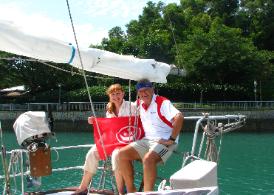
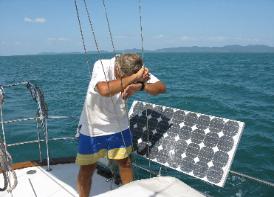
OUCH................this hurts!!!
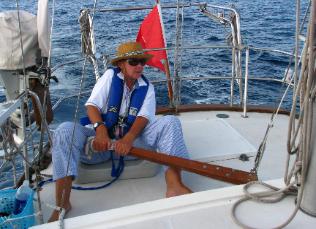
G. T. on the emergency tiller. One hour
on and one off. We did this for 52
hours.....not fun, but we managed.
on and one off. We did this for 52
hours.....not fun, but we managed.
 | |  | |  |
| | | | |